Параметры выходного напряжения в импульсных источниках питания MEAN WELL
В большинстве случаев для выбора источника питания достаточно двух основных параметров – выходное напряжение и выходной ток, которые определяют мощность источника питания. Такое упрощение возможно для ряда нагрузок, где допускается варьирование выходных параметров источника питания в достаточно широких пределах. Однако для оценки применимости блока питания в конкретных условиях эксплуатации компания MEAN WELL приводит ряд дополнительных параметров выходного напряжения, которые можно или следует учитывать при выборе:
Отклонение напряжения
Отклонение напряжения (Voltage Tolerance) – относительная величина (выражается в процентах), характеризует возможное и допустимое отклонение от номинального уровня. Как правило, это величина учитывает дополнительные отклонения стабильности по входу (сети) и выходу и позволяет оценить максимальное отклонение напряжения от номинального значения.
Пульсации и шум
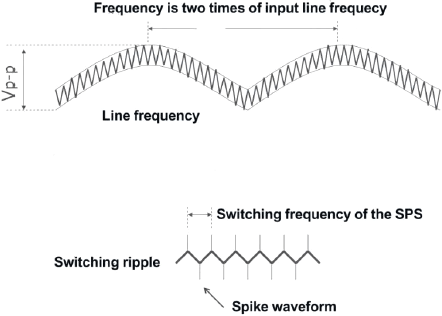
Пульсации и шум (Ripple and Noise) – абсолютная величина (выражается, как правило, в мВ) размаха напряжения, характеризующая частотные компоненты в выходном напряжении постоянного тока в импульсных источниках питания. Пульсации возникают как следствие выпрямления входного напряжения сети в выпрямителе блока питания; частота пульсаций равна удвоенной частоте сети. Шум – это вторая частотная компонента, возникает за счет работы ключевых элементов БП в импульсном режиме.
Стабильность по входу/сети
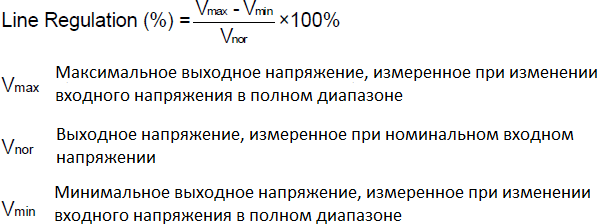
Стабильность по входу/сети (Line Regulation) – относительная величина, характеризует изменение выходного напряжения при изменении входного напряжения в допустимом диапазоне. То есть параметр стабильность по входу позволяет оценить качество работы импульсного источника питания в условиях нестабильной сети. Определяется по формуле:
Стабильность по выходу
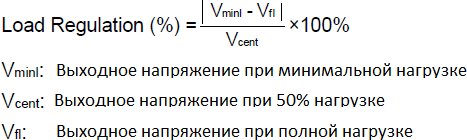
Стабильность по выходу (Load Regulation) – относительная величина, характеризует изменение выходного напряжения при изменении нагрузки на трех уровнях – минимальная нагрузка, максимальная, и половина. То есть параметр стабильность по выходу позволяет оценить качество работы импульсного источника питания в условиях нестабильной или вариативной нагрузки, подключенной к блоку питания. Определяется по формуле:
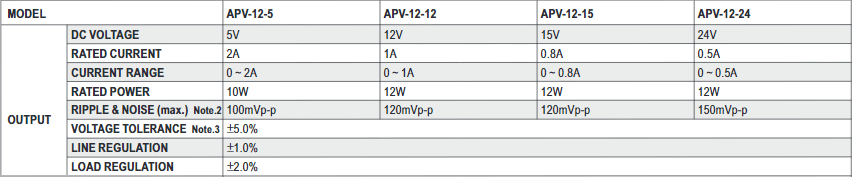
Значения параметров выходного напряжения в импульсных источниках питания зависят от применяемой топологии, мощности, ширины ряда выходных напряжений в серии и назначения блоков питания. Так, например, для светодиодных источников питания малой мощности APV-12 характерны невысокие параметры:
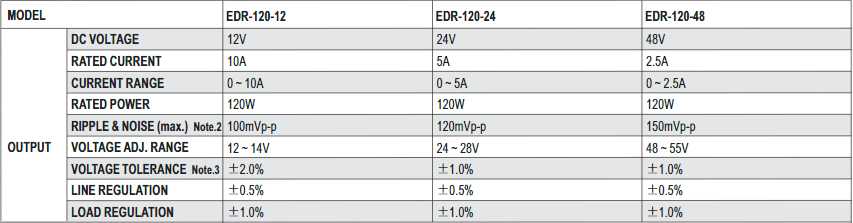
А для блоков питания на DIN-рейку серии EDR-120 значения параметров уже значительно лучше и соответствуют значениям для серий блоков питания промышленного применения:
Для консультирования или уточнения информации по источникам питания MEAN WELL обращайтесь по адресу электронной почты Meanwell@chipdip.ru.
-
- Магазины и оптовые отделы
- Видео
- Новости
- Каталог производителей
- Каталоги автозапчастей
- Акции и спецпредложения
- Калькуляторы
- Обратная связь
Line regulation load regulation что это

- Products
- Product Selector
- AC Power Sources
- DC Power Supplies
- DC Bench Power
- Electronic Loads
- Engineered Systems
- Modular Power
- Test Compliance
- Case Studies
- Industries
- Resource Guides
- White Papers
- Reliability Assurance
- RMA Request
- RMA Status
- Service Centers
- Technical Support
- Warranty Information
- Terms & Conditions
- Compliance Resources
- Counterfeit Parts Prevention Program
- The Company
- Contact Us
- Quality
- Supplier Resources
- Blog
- Careers
- Online Store
- Product News
- Programmable Power Sales
- Integrators
- Request a Quote
How To Choose Load Regulation for Power Supplies
Posted by Bill Martin on Sep 3, 2017 9:23:02 AM
The most important thing that a power supply does is to maintain a constant voltage output or a constant current output. This is true whether the power supply is built into a product and provides fixed output voltages, such as a desktop computer power supply, or a power supply that is on the test bench or is part of an automated test system that must provide variable outputs. We call this ability to maintain a constant output voltage or current regulation.

The Sorensen XG 1500 Series is an industry leading programmable DC power supply designed for test, production, laboratory,OEM and quality assurance applications. The XG 1500 is a 1500 Watt, 1U programmable power supply with constant voltage and constant current modes, automatic cross-over and numerous features enabling cost effective,easy integration.
Load regulation
There are actually two types of regulation that you need to be aware of when selecting a power supply: load regulation and line regulation. Load regulation is the ability of a power supply to maintain a constant output voltage (or current) under under very light loads and under loads near the maximum current. That is to say that if you set the output voltage of a supply to say 10 VDC, the supply should be able to maintain its output at 10 VDC when no current is being drawn from the supply and when the maximum current is being drawn from the supply.
To see how this might work in practice, let’s take a look at the Sorensen XG 12.5-120, one of the supplies in the XG 1500 Series. It can supply up to 12.5 VDC at currents up to 120 A. The load regulation for the XG 1500 Series is specified to be 0.005% of rated output voltage + 2 mV. For a 10 V output, that works out to be 2.5 mV, from no load to 120 A.
Line regulation
The calculations for load regulation assumes that the AC input voltage will remain constant. Of course, this is not always the case. AC line voltage can change, and this can also affect the output of a power supply. The ability of a power supply to maintain a constant output voltage when the input voltage changes is called line regulation.
The line regulation for the XG 1500 Series is also 0.005% of rated output voltage + 2 mV, assuming a constant load. For a 10 V output, that works out to be 2.5 mV, with an input voltage of 85-132 VAC for the nominally 110 VAC model, or an input voltage of 170-265 VAC for the nominally 220 VAC model.
Load and line regulation aren’t the only specifications that affect a power supply’s output. In some applications, for example, transient response time is also important. Load and line regulation are baseline specifications, though. Without good line and load regulation, the other specifications are meaningless.
For more information on DC power supplies, and how to use them in your application, contact AMETEK Programmable Power. You can send an e-mail to sales.ppd@ametek.com or phone 800-733-5427.
What is line regulation and load regulation?
Voltage regulation is classified into line regulation and load regulation. In line regulation output voltage is regulated when the input voltage changes. The purpose of load regulation is regulating output voltage when theload changes.
What is a regulation in zener diode?
The function of a regulator is to provide a constant output voltage to a load connected in parallel with it in spite of the ripples in the supply voltage or the variation in the load current and the zener diode will continue to regulate the voltage until the diodes current falls below the minimum IZ(min) value in the …
How do load and line regulation differ?
Line regulation is the ability to maintain specified output voltage over changes in the input line voltage. Load regulation is the ability to maintain specified output voltage over changes in the value of the load.
What is the formula of load regulation?
Load regulation (percent) = 100 x (voltage no load — voltage full load) divided by voltage full load. Line regulation is the amount of voltage variation from the output of a voltage regulator, or a transformer, that results from a change of voltage at the input of the voltage regulator or transformer.
What if Zener diode is forward biased?
When Zener diode is biased in the forward direction it behaves like a normal signal diode passing the current increasing linearly with voltage, but as soon as a reverse voltage applied across the Zener diode attains the breakdown voltage of the device, a large current starts to flow through the diode.
How is load regulation calculated?
Load regulation (percent) = 100 x (voltage no load — voltage full load) divided by voltage full load. Line regulation is another measure of voltage regulation.
How do you increase line regulation?
As such, the line regulation can be improved by improving the open loop gain, The line regulation for an unregulated power supply is usually very high for a majority of operations, but this can be improved by using a voltage regulator.
What is the line regulation for a Zener diode?
9/8/2005 Line Regulation.doc 1/4 Jim Stiles The Univ. of Kansas Dept. of EECS Line Regulation Since the Zener diode in a shunt regulator has some small (but non-zero) dynamic resistance r Z, we find that the load voltage V O will have a smalldependence on source voltage V S. In other words, if the source voltage V Sincreases
What is the line and load voltage regulation?
Line regulation: 1.2% Load regulation: 7.5% So for changes in line input voltage the output voltage can vary by +-144mV and for changes in line load output voltage can vary by +-900mV. So the actual output voltage will be in the range of 10.97V to 13.04V.
How is the output voltage of a DC diode regulated?
Hence a regulated DC output voltage V 0 = V Z is obtained across RL, whenever the input voltage remains within a minimum and maximum voltage. Basically there are two type of regulations such as: In this type of regulation, series resistance and load resistance are fixed, only input voltage is changing.
Is the DC voltage greater than the Zener diode?
The supply voltage VS must be greater than VZ. One small problem with zener diode stabiliser circuits is that the diode can sometimes generate electrical noise on top of the DC supply as it tries to stabilise the voltage.
What is line regulation and its formula?
The value is calculated from the ratio of the change in the output voltage to the change in the input voltage, but usually expressed as a percentage: Line Regulation = ΔVo/ΔVi. It is often desirable for a power supply to maintain a stable output regardless of changes in the input voltage, load or connected device.
What is a good line regulation?
Line regulation is the ability of a power supply to maintain a constant output voltage despite changes to the input voltage, with the output current drawn from the power supply remaining constant. In practice, a well regulated power supply should have a line regulation of at most 0.1%. …
What do you mean by line regulation?
Line regulation is the ability of a power supply to maintain a constant output voltage despite changes to the input voltage, with the output current drawn from the power supply remaining constant. A low line regulation is always preferred.
How do you calculate line regulation in a circuit?
The formula for line regulation is very simple, and you will need a voltage output measuring meter to make the necessary calculations. Start by measuring the initial voltage output for a given circuit, then write down the largest deviation from this initial voltage over the next 10 measurements.
How is line regulation related to load regulation?
Line regulation. Line regulation is the ability of the power supply to maintain its specified output voltage over changes in the input line voltage. It is expressed as percent of change in the output voltage relative to the change in the input line voltage. Load Regulation
Do you need a meter to calculate line regulation?
This can cause malfunctioning of appliances or even short circuiting. The formula for line regulation is very simple, and you will need a voltage output measuring meter to make the necessary calculations.
How is line regulation used in power supply?
Line regulation Line regulation is the ability of the power supply to maintain its specified output voltage over changes in the input line voltage. It is expressed as percent of change in the output voltage relative to the change in the input line voltage.